My Coach (Working Title)
My Foundation Skills Coach
We want NCCC's honest reaction before we finalise the proposal.
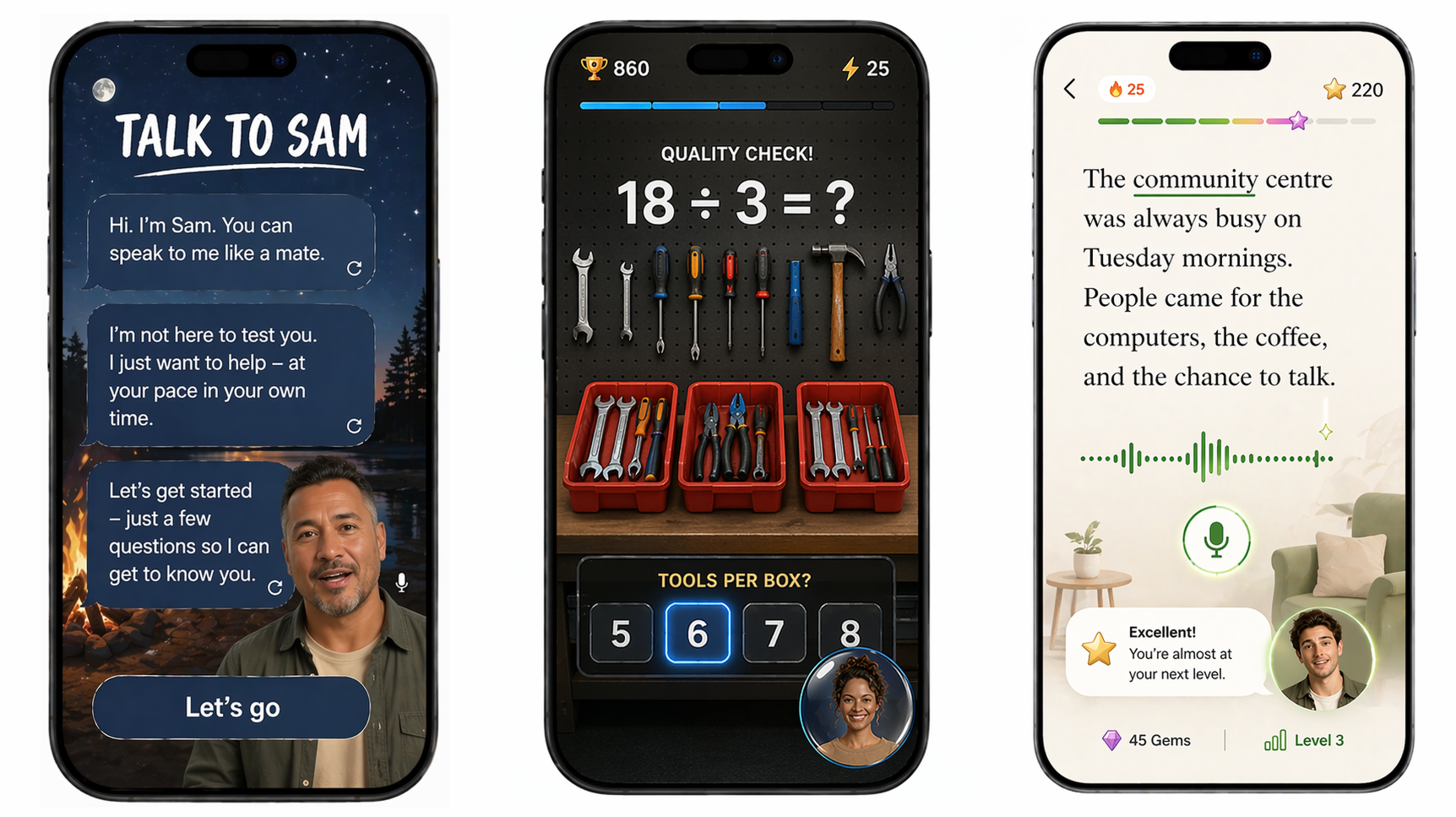
My Coach in three moments — a conversation that starts before any learning begins, a game that makes maths feel real, and a patient listener who never interrupts.
Meet Alyssa
Alyssa is 18. She's a Bundjalung woman from a small community on the Far North Coast of New South Wales. She left school in Year 9 — not because she couldn't learn, but because school never felt like it was built for her. The curriculum had nothing to do with her life, her community, or her culture. Teachers came and went. The environment never felt safe, and it never felt relevant. She's sharp, and she knows it. But formal education sent her the opposite message.
A community worker she trusts tells her about something new. She's sceptical. She's heard this before.
She opens it at the community centre on the Wi-Fi. There's no login screen demanding her details. No assessment. No welcome screen that looks like a government form. Just a voice — warm, unhurried — asking her a few questions about herself. Not testing her. Just curious.
The voice belongs to a face in the corner of the screen. Someone who looks like she could be from Alyssa's world. Someone her age. The face is speaking directly to her, not at her.
She doesn't finish that first session. But she comes back the next day. And when she does, the voice remembers exactly where she left off. No prompts. No "Let's start from the beginning." It just picks up — as if the conversation never stopped.
That moment — being remembered, without having to explain yourself — is the whole product.
For adults who left education feeling like they failed it, being remembered is what makes coming back feel safe.
Alyssa is one of three personas we've developed for this project. → Full Personas → Alyssa's Journey
The problem: who is missing out, and why
Foundation skills — numeracy, reading, and writing — are the floor beneath every other pathway. Without them, VET courses, employment programs, and further education are out of reach. The adults who most need these skills are precisely the adults the current system is least equipped to reach.
Who we're talking about → Product Vision
The NSW Foundation Skills program explicitly targets five priority groups. NCCC's learner community sits squarely in their overlap:
- Adults with low literacy or numeracy — ACSF Levels 1–2. The people for whom every job application, every form, and every workplace sign is a private daily challenge.
- Culturally and Linguistically Diverse (CALD) communities — including English language learners at all stages. Written English remains a gap long after spoken English becomes functional.
- Aboriginal and Torres Strait Islander learners — aligned with Closing the Gap targets, and specifically with the Barranggirra fee-free training initiative in NSW.
- Long-term unemployed job seekers — 12 or more months out of work. Around 65 per cent face at least one additional employment barrier beyond unemployment itself.
- Regional, rural, and remote Australians — for whom community education providers are the primary delivery channel, and often the only one.
Why the current system fails them
It's not that options don't exist. It's that the options that exist weren't designed for this audience:
- Face-to-face programs are constrained by geography, timetables, transport, cost, and — most importantly — the shame of walking through a door into a room that feels like school.
- Existing digital tools are transactional and score-first. They were designed for motivated users with good devices and reliable internet. They were not designed for Alyssa, or for Deb, or for Marcus.
- Nothing in between is simultaneously conversational, private, mobile-first, and genuinely accessible on a basic smartphone with patchy coverage.
The specific barriers that persist
- Shame and re-entry anxiety. Adults returning after years away need a low-stakes first step. Not a form. Not a test. A conversation.
- Geography and transport. Learners in remote communities can't reach a classroom reliably, or at all.
- Device and connectivity constraints. Shared phones, older handsets, 3G or community Wi-Fi only. This is the baseline, not the exception.
- Irregular availability. Caring responsibilities, seasonal work, and mental health mean learners can't commit to a schedule. They need something they can pick up and put down without losing their place.
- Cultural disconnect. For Aboriginal and Torres Strait Islander learners especially, tools built by and for non-Indigenous people and dropped into community are immediately recognisable — and immediately closed.
The gap is clear: there is no tool that is a genuine conversation, remembers the learner, works on any phone, and was built with communities like Alyssa's in mind.
That's what we're building.
The solution: My Coach
My Coach (My Foundation Skills Coach) is a mobile-first platform that puts a Foundation Skills specialist in every learner's pocket — available any time, on any device, at their pace.
It is not a recording. It is not a content pathway. It is not an app that plays the same content to every learner regardless of who they are. It is a conversation — one that responds to this learner, in this moment, with memory of every session they have had together.
→ Architecture Diagram → Storyboard: Alyssa's Journey → Screen Mockups
The Shell — the relationship layer → Coach & Interaction Model
At the heart of the product is what we call the Shell: the persistent AI relationship between the Coach and the learner. This is what makes My Coach fundamentally different from every other tool in this space.
The Shell does not teach numeracy or reading. It does something more important: it knows the learner, holds their history, and shows up the same way every single time — warm, patient, and specific to them.
The Shell is responsible for:
- Conversational onboarding. The Coach gathers the learner's goals, background, and communication style through dialogue — not a form, not an assessment. It feels like meeting someone, not signing up for something.
- Persistent memory. Every session opens with a demonstration that the Coach remembers: what was worked on last time, what was hard, what was achieved. No re-explaining required.
- The 3D video avatar. A realistic, speaking Coach appears in the bottom-right corner of the screen at key moments — session opening, feedback delivery, when the learner seems stuck, session close. It speaks with lip-synced voice audio, then steps back. Between key moments, it is completely absent, so the learning is foregrounded. → Avatar Direction
- Matched representation. The avatar pool is matched to the learner's cultural background, age, and communication style, gathered conversationally during onboarding. Alyssa gets a Coach who looks like someone from her world. Deb gets a Coach who is closer to her own life stage.
- Re-engagement. After any gap — a day, a week, a month — the Coach picks up exactly where the learner left off. No guilt. No mention of how long it has been. Just: here is what you were working on.
"A Foundation Skills specialist available to every learner, any time."
That is the access-equity argument for remote NSW — and it is only possible because of the Shell.
The modules — plugged into the Shell → Full Feature Inventory
The Shell wraps learning modules, each with its own distinct experience and visual personality. The transition between them is intentional: a brief moment with the Coach before and after each session.
Critically, the module architecture is designed to grow. New modules, new content areas, and new technologies can be added without rebuilding the relationship layer. The Coach already knows the learner when they arrive somewhere new.
Numeracy — Bold and alive → Visual Direction
The numeracy module is a gamified mobile experience — fast-paced, satisfying, designed for short sessions on any phone. During gameplay the Coach is completely absent: the module is fully foregrounded and the learner is in the game.
After each session, the Coach reappears in the corner. It delivers specific, spoken feedback — not a score, not a percentage, but a clear statement of what the learner did well and the one thing to focus on next. It connects that skill to what the learner said they actually care about: reading a payslip, working out change, understanding a roster.
Designed for learners who have always been told they are bad at maths. Confidence first, skill second. → Marcus's Journey
Reading — Calm and intimate → Visual Direction
The reading module is built around one simple act: the learner reads aloud, and the Coach listens.
In real time, the Coach tracks pronunciation, pace, and word recognition. It does not interrupt. When the passage is finished, the Coach speaks the feedback — it doesn't just display it. For learners who struggle with reading, hearing the feedback matters as much as seeing it.
The learner can read from any text. A book they already have. A letter they received. A form they need to fill in. The Coach works with whatever the learner brings.
The Coach listens the way a patient, interested person listens — without judgment, without rushing. → Alyssa's Journey
Writing — Warm and encouraging → Visual Direction
The writing module has two pathways, because not every learner has the same device or the same confidence.
Learners with more tech confidence can write directly on-screen using a finger or stylus. Learners who are more comfortable with pen and paper — like Deb, who has been writing by hand her whole life — write on paper, and scan it with their device camera. The AI reads the handwriting and the Coach delivers the same warm, specific feedback either way.
Feedback is always spoken. Always specific: what worked, and one small thing to focus on next. Never a score. Never a grade.
The paper-and-photo pathway is the universal access feature. No keyboard required. No typing confidence required. No one left out. → Deb's Journey
How the learner interacts with the Coach
When the Coach appears in the corner of the screen, the learner is never a passive audience. Three simple controls are always available on the avatar overlay:
- Replay — hear it again. Critical for low-literacy learners who process at their own pace.
- Skip — move on when they're ready.
- Speak back — respond by voice. This is the primary interaction. Not a tap, not a type — a conversation.
Three design principles that matter most for NCCC's community → All 9 Principles
| Earn trust before asking for effort | The first session is a conversation, not an assessment. The Coach does not rush to evaluate or categorise. It is curious about the learner, not clinical. If the first session feels like a test, Alyssa closes it and does not return. |
| Memory is the trust mechanism | Being remembered removes the shame of having to start over. For adults returning to learning after years away, persistent and specific memory is not a nice-to-have. It is what makes the Coach feel like a relationship rather than a service. |
| Meet them where they are | Works on any smartphone, any connection speed. The writing module works with pen and paper and a phone camera. If a feature only works well for well-equipped users, it is not ready. |
The long-term vision: what this becomes
The pilot is where the product proves itself in community. It is not the ceiling.
The Shell-and-modules architecture is deliberately built to evolve. Once the Coach is trusted by learners and proven in community, it becomes the platform for a much larger product. The pilot is the investment that establishes the relationship layer — and everything else plugs into it.
An AI that learns over time
In the pilot, the Coach responds to each learner individually — remembering their history, adapting its pacing and language to what works for them. Over time, with more learners, the AI learns patterns across the whole community: which approaches work for which learner profiles, where people consistently get stuck, what brings people back after a gap.
The Coach gets better with every conversation — not just for one learner, but for every learner who comes after. This is the compounding value of an AI-native platform: it doesn't just deliver the same content faster. It improves through use.
More foundation skills modules → Future Features
The pilot launches with three modules: numeracy, reading, and writing. These are the core — but they are not the limit.
Because the Shell is a separate layer from the modules, new skill areas can be added without rebuilding the relationship layer. The Coach already knows the learner when they arrive somewhere new. They do not start over.
Future modules could include: oral communication for workplace contexts; digital literacy; financial literacy; and employability skills — job applications, workplace documents, interview preparation. Each new module extends the platform's reach without rebuilding it.
More devices, more places
The pilot is mobile-first and browser-based — designed for the shared phone on 4G. That is the floor, not the ceiling. The same Shell and modules extend naturally to tablets, community centre kiosks, larger screens for small group use, and smart TVs for shared household use in remote communities. Wherever a learner can get to a screen — any screen — the Coach is there. And the Coach already knows them.
Foundation skills are the entry point to every other pathway: VET, employment programs, community leadership, further education.
A platform that reaches Alyssa at 18 — on her phone, at the community centre, with a Coach who looks like someone from her world — does not just improve her literacy. It opens every door that literacy opens.
Who this reaches
Every design decision in My Coach traces back to the specific barriers faced by the people it is built for. This section maps those decisions to NCCC's community.
Adults with low literacy or numeracy → Meet Deb
- Audio-first feedback. All Coach dialogue is spoken, not just displayed. Learners who struggle to read on-screen are not disadvantaged.
- ACSF Level 2 language throughout. Short sentences, common words, active voice. No jargon.
- No score-first UX. The Coach never uses a number as the primary feedback mechanism. It tells the learner what they actually did and what to do next.
- Errors treated as information. The Coach never signals disappointment or frustration. It frames mistakes as part of learning, not evidence of failure.
CALD and English language learners → Meet Marcus
- No idiom. The Coach never uses Australian colloquialisms or expressions that assume a shared cultural context.
- Plain language always. Designed to be understood by someone processing in a second language.
- CALD avatar representation. The avatar pool includes characters from a range of cultural backgrounds, matched to the learner during onboarding.
Aboriginal and Torres Strait Islander learners → Meet Alyssa
- Developed with, not for, community. Avatar characters and cultural content are developed in consultation with relevant community representatives. This is a Pilot requirement, not a future consideration.
- Bundjalung-connected characters where possible. For learners on the Far North Coast, representation matters from the first screen.
- Barranggirra alignment. The fee-free pathway supported by the Barranggirra initiative removes the financial barrier for this cohort.
- No cultural appropriation. Aboriginal visual motifs are not used decoratively. Cultural consultation governs all design decisions involving Indigenous representation.
Long-term unemployed job seekers
- Confidence first, skill second. The primary goal is for learners to believe they can improve. Skill gains follow.
- No shame mechanics. No leaderboards, no visible scores, no comparisons with other learners. Progress is private, always.
- Connected to workplace goals. The Coach connects daily practice to what the learner said they actually want: a job application, a form, a workplace document.
Regional, rural, and remote Australians
- Mobile-first, low-bandwidth. Works on 3G and community Wi-Fi. The app degrades gracefully on poor connections.
- No download required. Runs in any smartphone browser. No app store, no install, no storage requirement.
- Paper-and-photo writing pathway. No keyboard required. Pen and paper is all a learner needs to start.
- No timetable. Available any time. A five-minute session is treated as normal, not incomplete.
The product does not ask learners to come to it. It goes to them.
The pilot plan → Full Feature Inventory
The pilot delivers the full Coach experience across three modules, from the first conversation through to re-engagement after a gap. It is complete and functional from day one — not a limited preview.
What ships in the pilot
| Feature | What it does | Tier |
|---|---|---|
| Conversational onboarding | Goals and profile gathered through dialogue, not a form | Pilot |
| Avatar assignment | Coach matched on cultural background, age, communication style | Pilot |
| 3D video avatar | Realistic speaking Coach, bottom-right overlay, key moments only | Pilot |
| Voice input and output | Learner speaks responses; Coach speaks all feedback | Pilot |
| Persistent memory | Every session opens with a reference to the last | Pilot |
| Numeracy game | Fast-paced gamified experience with post-session AI feedback | Pilot |
| Read-aloud with feedback | Learner reads aloud; Coach listens and responds | Pilot |
| Paper-and-photo writing | Write on paper, scan — full feedback returned | Pilot |
| Private progress view | Learner sees their own history, framed as movement not scores | Pilot |
| Re-engagement recovery | Warm restart after any gap, no guilt, no mention of absence | Pilot |
| Mobile-first, no download | Runs in any smartphone browser on 4G or Wi-Fi | Pilot |
| No-account quick start | First session begins without creating an account | Pilot |
Phase 2 — after the pilot → Phase 2 Features
Once the pilot is proven in community, Phase 2 extends the platform with:
- Proactive re-engagement. The Coach reaches out after a period of absence — a gentle, specific message referencing the learner's last session.
- Community worker dashboard. Facilitators at NCCC can see which learners are active and who might benefit from a check-in — without seeing individual learner data.
- Offline mode. Core session content pre-loads for use without a connection. Progress syncs when connectivity returns.
- Desktop and tablet support. Experience extended and optimised for larger screens.
NCCC's role
We are asking NCCC to be an active partner in the pilot, not a passive host. That could mean:
- Community advisory input during build — cultural safety review, learner needs, avatar development feedback.
- Pilot site — facilitating learner access through existing community worker relationships.
- Feedback loop — regular input from community workers and learners feeding directly into product iteration.
NCCC's knowledge of the learner community is not a nice-to-have for this project. It is essential. The Coach can only be culturally safe if it is built with community, and NCCC is that community.
What we're asking for today
This document is a draft. Its purpose is to get NCCC's honest reaction before we finalise the submission.
We are not asking for an endorsement. We are asking for the feedback that will make this product better — and more genuinely useful to the community NCCC serves.
Three questions for NCCC
- Does this reach the learners you work with? Who does it fit well? Who might it miss? Where are the gaps between what we've described and the reality of your community?
- What would make a community worker confident recommending this? What would a community worker need to see, hear, or experience before they'd put Alyssa's name behind it?
- What concerns do you have? Cultural safety, data privacy, the AI interaction model, the avatar approach — what are the hard questions we should be answering before this goes further?
Your feedback will shape the final submission to NSW DoE.
If this product is going to work for Alyssa, it has to be built with the people who know her — not just for them.
Next steps
- NCCC provides written or verbal feedback on this draft.
- Feedback is incorporated into the final proposal.
- Build and pilot to follow funding approval.
Contact — Jason Bentley, NSW Department of Education, Training Services