Module assignments: Deb → Writing (paper-and-photo pathway), Marcus → Numeracy (gamified, fits shift-work), Alyssa → Reading (audio-based, low-barrier entry).
→ Full Persona Profiles
→ Product Principles
Journey 1 — Deb and the Writing Module
Deb, 54. Small town, Far North Coast NSW. Shared Android phone, 3G at home. Hidden literacy gap, long-term unemployed. Came through a community services referral.
Stage 1 — First contact
| Step | What happens | Emotional state |
|---|
| 1.1 | A community worker mentions the Coach to Deb in passing. No pressure — just "there's an app some people have found useful." | Curious but guarded. She's heard this kind of thing before. |
| 1.2 | Deb looks up the app on her phone at home that evening. The landing screen is warm and plain — no jargon, no promises that feel too big. | Slightly less guarded. It doesn't look like a government form. |
| 1.3 | She sees "Your progress is private. Only you can see it." on the first screen, before she's asked to do anything. | Relieved. This is the thing she needed to hear first. |
Stage 2 — Onboarding
| Step | What happens | Emotional state |
|---|
| 2.1 | The Coach introduces itself conversationally: "Hi, I'm here to help you build your skills, at your pace. Can I ask you a couple of things to get started?" | Cautious but willing. The tone doesn't feel like a test. |
| 2.2 | The Coach asks what she'd like to get better at. She says "reading and writing, I suppose." | Vulnerable. She's said it out loud for the first time in years. |
| 2.3 | The Coach responds warmly, doesn't make a big deal of it, and suggests starting with writing since that's where she mentioned the most frustration. | Tentatively hopeful. It heard her. |
| 2.4 | The Coach explains the writing module simply: "You can write on paper and take a photo — you don't have to type if you don't want to." | Visibly relieved. The barrier she feared most just disappeared. |
Stage 3 — First module session (Writing)
| Step | What happens | Emotional state |
|---|
| 3.1 | The Coach gives her a simple, low-stakes prompt: "Write a few sentences about something you know well — your work, your family, anything." | Nervous. But the prompt is open-ended and non-threatening. |
| 3.2 | She writes on paper, takes a photo, and uploads it. The process works first time. | Surprised it was that easy. A small moment of competence. |
| 3.3 | The Coach responds with specific, positive feedback first: "You used clear, direct sentences — that's a real strength." Then one gentle suggestion: "Let's look at full stops — I'll show you a simple way to think about them." | Emotional. No one has ever said something she wrote was good before. |
| 3.4 | She tries a second short exercise. The Coach shows her the full stop pattern. She gets it mostly right. | Growing confidence. She's still nervous but she's doing it. |
| 3.5 | The Coach closes the session: "That was a strong first session, Deb. You wrote more than you think you did. Come back when you're ready — I'll remember where we got to." | Warm and settled. She didn't fail. She came back tomorrow. |
Stage 4 — Re-engagement
| Step | What happens | Emotional state |
|---|
| 4.1 | Three days later she's at the library with better Wi-Fi. She opens the app. The Coach greets her by name and references the last session specifically. | Welcomed. It remembered. |
| 4.2 | The Coach offers a choice: "We could keep working on punctuation, or try a slightly longer piece — what feels right today?" | Agency. She's being asked, not directed. |
| 4.3 | Over several weeks, the Coach moves her toward writing a short cover letter — her actual goal. It never calls it that until she's ready. | Steadily more confident. The goal is approaching without feeling overwhelming. |
Journey 2 — Marcus and the Numeracy Module
Marcus, 34. Regional NSW, 90 min from a major centre. Own smartphone, standard data. CALD/EALD, long-term unemployed, casual work history.
Stage 1 — First contact
| Step | What happens | Emotional state |
|---|
| 1.1 | Marcus hears about the Coach through a job services provider who mentions it at an appointment. He's shown a QR code. | Mild interest. He's used apps before. Not overly hopeful but willing to try. |
| 1.2 | He opens it that night after putting the kids to bed. It loads quickly on his phone. | Neutral. Checking it out. |
| 1.3 | The onboarding language is plain and doesn't assume much. No idiom, no cultural shorthand. | Comfortable. It's not talking down to him or past him. |
Stage 2 — Onboarding
| Step | What happens | Emotional state |
|---|
| 2.1 | The Coach asks what he's hoping to work on. He mentions he wants to get better with "numbers at work — like rosters and calculations." | Straightforward. He knows what he wants. |
| 2.2 | The Coach suggests the numeracy module and briefly explains the game-style format. It shows a quick preview. | Intrigued. The game format is unexpected — in a good way. |
| 2.3 | The Coach notes: "Sessions are short — you can stop anytime and pick up exactly where you left off." | Practical relief. This fits around his life. |
Stage 3 — First module session (Numeracy)
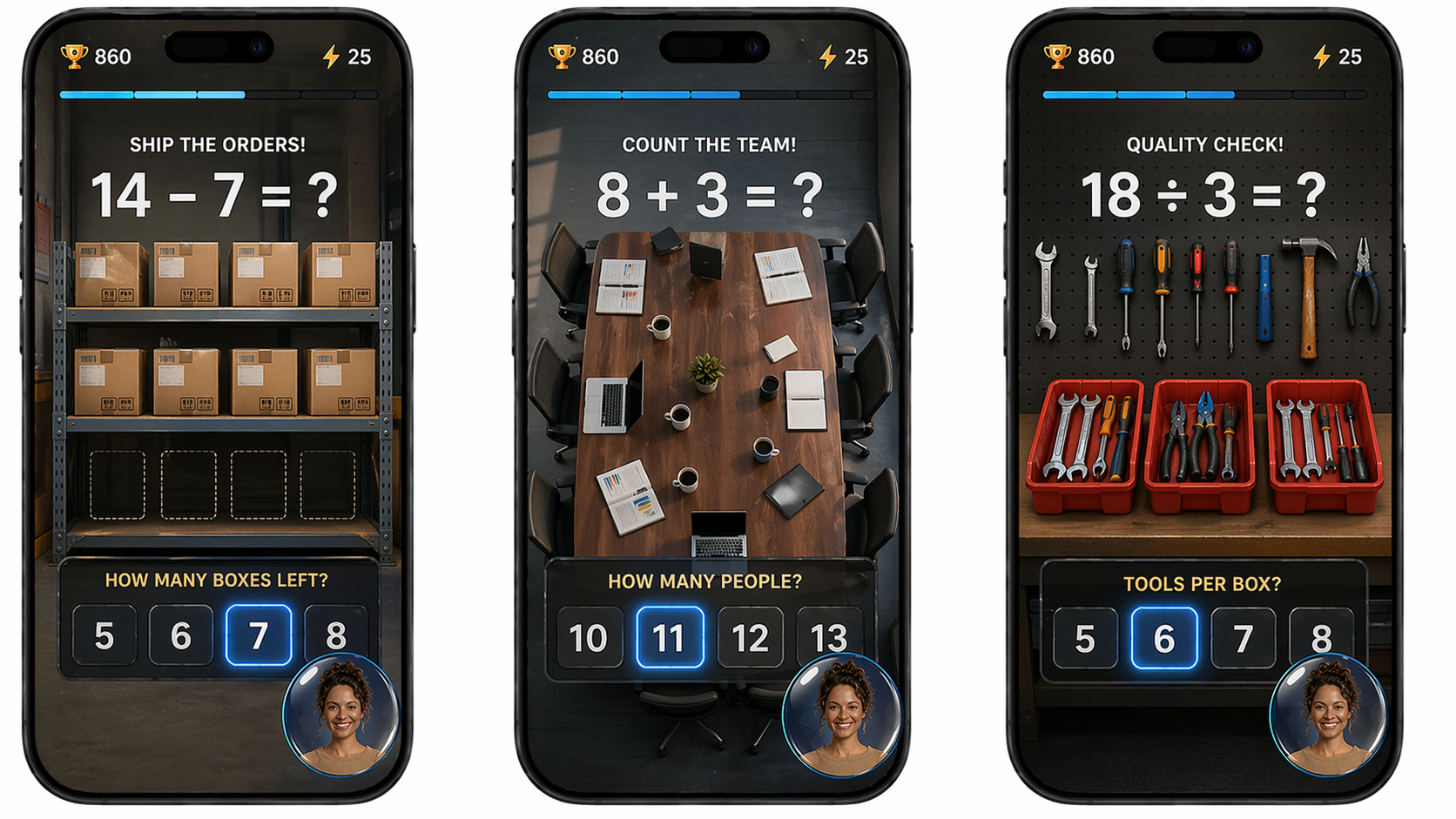
The numeracy game in action — equations grounded in workplace scenarios (boxes to ship, team size, tools per box). The Coach avatar is a small pip at the bottom; the game world is foregrounded. → All numeracy mockup variants
| Step | What happens | Emotional state |
|---|
| 3.1 | The numeracy game starts at a level calibrated to him — not insultingly easy, not overwhelming. | Engaged. It's actually kind of fun. |
| 3.2 | He plays for about 8 minutes before he has to stop — his toddler wakes up. He closes the app mid-session. | No anxiety about stopping. The app didn't punish the interruption. |
| 3.3 | Next morning on his break, he reopens it. The Coach picks up exactly where the game left off. | Pleased. It kept its word. |
| 3.4 | After the session, the Coach gives him a short plain-language summary: "You're solid on addition and subtraction. Multiplication is the next step — let's try that next time." | Clear and grounded. Not a grade. Just useful information. |
| 3.5 | The Coach connects the skill to his goal: "Roster calculations use multiplication a lot — you'll be able to do those in your head soon." | Motivated. He can see the relevance directly. |
Stage 4 — Re-engagement
| Step | What happens | Emotional state |
|---|
| 4.1 | He drops off for two weeks — a run of casual shifts and family commitments. When he comes back, the Coach doesn't make him feel guilty about the gap. | Relieved. No shame for being inconsistent. |
| 4.2 | The Coach does a quick warm-up on what he covered before, then moves forward. | Settled back in quickly. No loss of progress. |
| 4.3 | After a month of irregular sessions, the Coach surfaces a word-problem exercise — the kind he'd see on a job application numeracy test. | A little anxious, but he tries it. He gets most of it right. |
| 4.4 | The Coach acknowledges the milestone: "That's the kind of question employers use in assessments — and you just answered it." | Quietly proud. He didn't expect to be here this soon. |
Journey 3 — Alyssa and the Reading Module
Alyssa, 18. Far North Coast NSW, small Bundjalung community. Older iPhone, spotty coverage, uses community centre Wi-Fi. Left school Year 9 — cultural disconnect. Systemic distrust of education. At the Coach via a trusted community worker.
Stage 1 — First contact
| Step | What happens | Emotional state |
|---|
| 1.1 | Her community worker — someone she has a real relationship with — sits with her and opens the app together. She's not alone with it for the first time. | Guarded but safe. She trusts this person. If they say it's okay, she'll look. |
| 1.2 | The first screen doesn't look like school. No worksheets, no "learning objectives," no progress bars visible yet. | Cautiously observing. She's looking for the catch. |
| 1.3 | The language is plain and warm. Nothing feels like a trap. She doesn't see anything that looks like a test. | Not yet committed, but not leaving either. |
Stage 2 — Onboarding
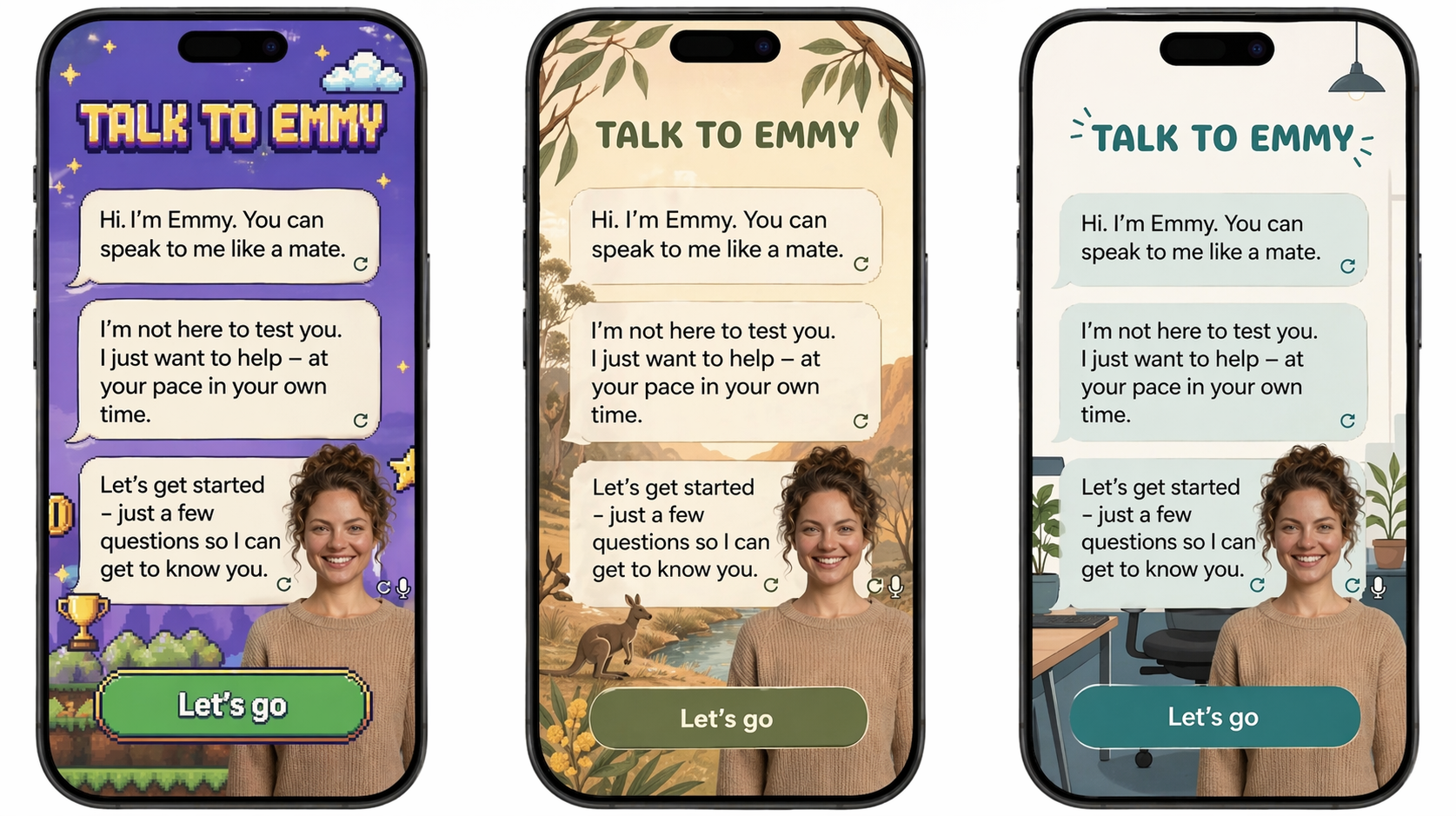
The Coach's opening screen — "Hi, I'm Emmy. You can speak to me like a mate." Three background variants show how the same warm introduction adapts to different learner worlds. → All Coach Arrives variants (Emmy, Matt, Sam)
| Step | What happens | Emotional state |
|---|
| 2.1 | The Coach opens: "I'm not here to grade you or tell you what you should know. I just want to help you with whatever feels useful." | Something loosens. That's not what school said. |
| 2.2 | The Coach asks gently: "Is there anything you find yourself wanting to read but it feels hard?" She says: "Messages sometimes. Signs." | Honest for the first time. The low-stakes question unlocked something. |
| 2.3 | The Coach doesn't turn this into a curriculum. It says: "Let's start with that. We'll just read things together." | She doesn't feel assessed. Just heard. |
| 2.4 | No formal module selection screen — the Coach guides her naturally toward reading without framing it as a category or a level. | She doesn't realise she's enrolled in anything. That's the point. |
Stage 3 — First module session (Reading)
| Step | What happens | Emotional state |
|---|
| 3.1 | The Coach offers her a short piece of text to read aloud — something ordinary and relevant, not a children's story or a textbook passage. | Wary. Reading aloud was where school hurt her. |
| 3.2 | She reads slowly, stumbles on a word. The Coach responds with calm audio feedback: "That word trips a lot of people up — here's how it sounds." No score. No red marks. | Surprised by the lack of judgement. She tries the word again. |
| 3.3 | She reads a second short passage. She gets through it. The Coach says: "You read that whole thing. That's not nothing." | A small crack in the armour. She half-smiles. |
| 3.4 | The session is short — about 10 minutes. The Coach ends it before she does. "That's enough for today. Same time, same place, whenever you want." | Unexpectedly okay. She didn't fail. The session ended on her terms. |
Stage 4 — Re-engagement
| Step | What happens | Emotional state |
|---|
| 4.1 | She doesn't come back for almost two weeks. When she does, the Coach greets her as if no time has passed: "Good to see you again." No lecture about the gap. | Trust holds. It didn't punish her. |
| 4.2 | Over several sessions, the Coach introduces slightly more complex texts — but frames them as "let's try something a bit different," never "harder." | She's reading more than she realises. The framing protects her confidence. |
| 4.3 | One day she asks the Coach unprompted: "Can we do something about my writing too?" | A turning point. She's no longer just tolerating the Coach — she's using it. |
| 4.4 | The Coach responds: "Absolutely. You've already got more to build on than you think." It transitions her to writing without making it feel like a new enrolment. | She feels capable for the first time in years. The goal she never said out loud is starting to feel possible. |
Cross-journey observations
These journeys, read together, surface several consistent design requirements:
- Onboarding must earn trust before asking for effort. All three personas are reluctant at the door. The first session is not about learning — it's about proving the Coach is safe.
- Stopping must be consequence-free. Marcus interrupts mid-session, Alyssa disappears for two weeks, Deb comes back after three days. The Coach must treat all of these as normal.
- Feedback is always private and specific. Generic praise lands poorly. Specific, honest, and warm is the register.
- Module transitions should feel like a conversation, not an enrolment. Alyssa's move from reading to writing is the clearest example.
- The Coach connects skills to the learner's actual goals. Marcus seeing roster calculations. Deb approaching a cover letter. Alyssa asking for writing herself.
→ Coach Personality & Interaction Model
→ Product Principles